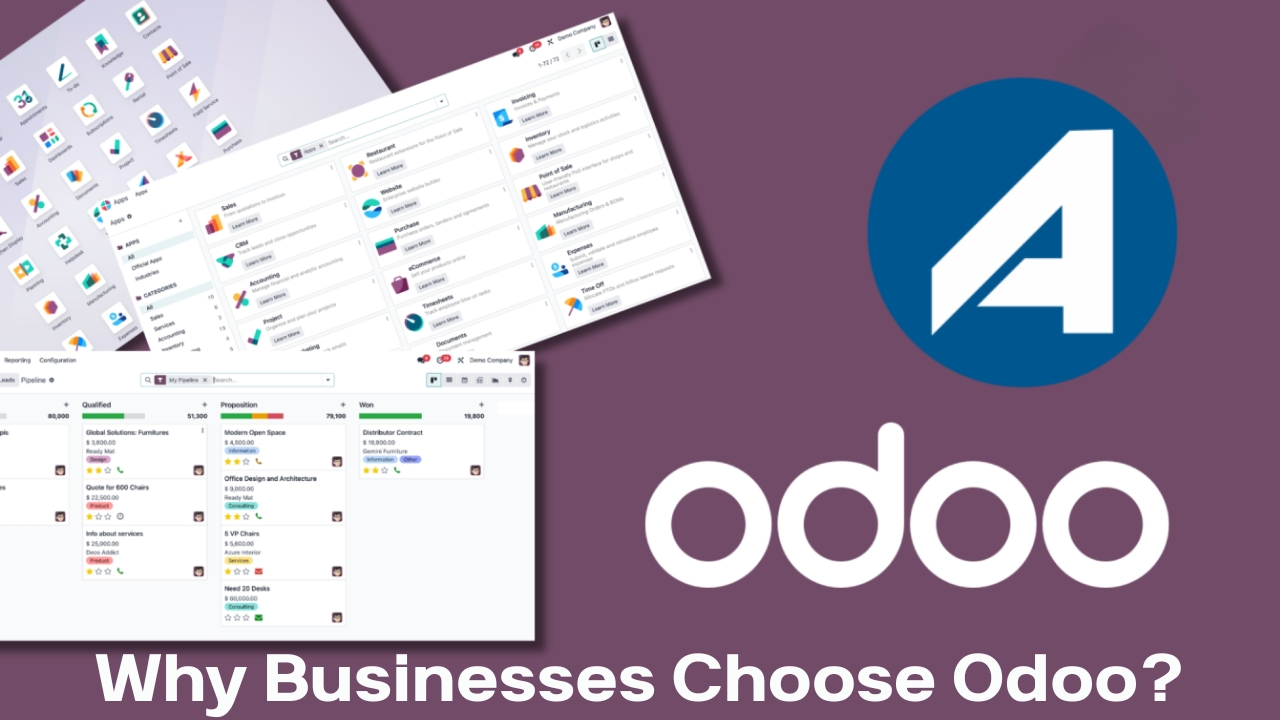
In today’s fast-changing business world, companies need software that is flexible, affordable, and powerful enough to grow with them. Managing sales, accounting, inventory, employees, customers, and marketing using different tools can quickly become confusing, expensive, and inefficient. This is why many businesses around the world are choosing Odoo.
Odoo is not just another software tool. It is a complete business management platform that helps companies run their entire operation from one place. From startups to large enterprises, businesses across industries are adopting Odoo to simplify processes, reduce costs, and improve productivity. In this detailed guide, we will explain why businesses choose Odoo, what makes it different from other ERP systems, and how it supports long-term growth—all in easy words, without technical jargon.
1. What Is Odoo?
Odoo is an open-source ERP (Enterprise Resource Planning) software that helps businesses manage all their operations in one system.
Odoo offers applications for:
- CRM and Sales
- Accounting and Finance
- Inventory and Purchase
- Manufacturing
- HR and Payroll
- Project Management
- Website and eCommerce
- Marketing Automation
Instead of using multiple disconnected tools, Odoo brings everything together into one unified platform.
2. Why Businesses Need an ERP System
As a business grows, managing operations manually or through spreadsheets becomes difficult.
Common problems include:
- Duplicate data entry
- Errors in reports
- Poor communication between departments
- No real-time visibility
- Wasted time and money
An ERP system solves these problems by:
- Centralizing data
- Automating workflows
- Improving accuracy
- Providing real-time insights
Odoo stands out because it makes ERP accessible, even for small and mid-sized businesses.
3. The Biggest Reasons Businesses Choose Odoo
There are many ERP systems in the market, but Odoo is often chosen for these key reasons:
- Flexibility
- Cost-effectiveness
- Ease of use
- Modular design
- Scalability
- Open-source foundation
Let’s explore these reasons in detail.
4. Odoo’s Modular Approach: Pay Only for What You Need
One of the biggest advantages of Odoo is its modular structure.
Instead of buying a large, expensive system with features you may never use, Odoo allows you to:
- Start with basic modules
- Add more apps as your business grows
- Avoid paying for unnecessary features
For example:
- A startup may start with CRM and Invoicing
- Later add Inventory and Accounting
- Eventually include HR, Manufacturing, or eCommerce
This approach makes Odoo very attractive to growing businesses.
5. Easy to Use and User-Friendly Interface
Many ERP systems are powerful but difficult to use. Odoo is different.
Odoo offers:
- Clean and modern interface
- App-based navigation
- Simple dashboards
- Minimal training for basic tasks
Employees adapt faster to Odoo, which reduces resistance to change and improves productivity.
6. Affordable ERP for Small and Growing Businesses
Cost is a major concern when choosing ERP software.
Odoo is often chosen because:
- Odoo Community Edition is free
- Odoo Enterprise is competitively priced
- Implementation costs are lower than many traditional ERPs
- You pay based on users and modules
This makes Odoo one of the most affordable ERP solutions in the market.
7. The Odoo Community vs Odoo Enterprise
Odoo Community
- Free and open-source
- Core ERP features
- Ideal for small businesses and startups
- Requires technical support from partners
Odoo Enterprise
- Paid version
- Advanced features
- Better UI and automation
- Official support from Odoo
Businesses can choose the version that best fits their needs and budget.
8. All-in-One Business Management Platform
Many businesses choose Odoo because it replaces multiple tools.
Instead of using:
- One tool for accounting
- Another for CRM
- Another for inventory
- Another for HR
Odoo handles everything in one system.
This reduces:
- Software costs
- Data duplication
- Integration issues
- Training time
9. Flexibility and Customization
Every business is unique. Odoo understands that.
Odoo allows:
- Custom workflows
- Custom fields
- Custom reports
- Third-party apps
- Full custom development
Because Odoo is open-source, it can be adapted to almost any business process.
10. Odoo for Sales and CRM Management
Odoo CRM helps businesses manage leads and customers efficiently.
Key benefits:
- Visual sales pipelines
- Automated follow-ups
- Email integration
- Lead tracking
- Forecasting and reporting
Sales teams can work faster and close deals more effectively.
11. Odoo for Accounting and Finance
Odoo Accounting simplifies financial management.
Features include:
- Invoicing and billing
- Accounts payable and receivable
- Bank reconciliation
- Tax management
- Financial reports
Because accounting is integrated with sales and inventory, data stays accurate and up to date.
12. Inventory and Supply Chain Management with Odoo
Odoo Inventory helps businesses:
- Track stock in real time
- Manage multiple warehouses
- Automate reordering
- Reduce stock shortages
- Avoid overstocking
This is especially useful for retail, wholesale, and manufacturing businesses.
13. Odoo for Manufacturing and Operations
Manufacturing companies choose Odoo for:
- Bill of Materials (BOM)
- Production planning
- Work orders
- Quality checks
- Cost tracking
Odoo helps manufacturers reduce waste and improve efficiency.
14. Odoo for Service-Based Businesses
Service companies such as IT firms, consultants, and agencies benefit from:
- Project management
- Timesheets
- Resource planning
- Client billing
This includes companies offering services like Social Media Marketing, where managing clients, projects, tasks, and invoices in one system saves time and improves profitability.
15. Odoo for Marketing and Customer Engagement
Odoo includes marketing tools such as:
- Email marketing
- SMS campaigns
- Marketing automation
- Lead nurturing
These tools work directly with CRM data, making campaigns more targeted and effective.
16. Odoo Website and eCommerce Capabilities
Odoo also includes:
- Website builder
- Online store
- Blog management
- Payment gateways
- SEO-friendly tools
This allows businesses to manage their online presence and backend operations from one platform.
17. Scalability: How Odoo Grows with Your Business
Odoo is designed to grow with your business.
You can:
- Add users
- Add modules
- Expand to multiple locations
- Manage multiple companies
This scalability makes Odoo a long-term solution.
18. Integration with Third-Party Tools
Odoo integrates with many external systems:
- Payment gateways
- Shipping providers
- Accounting tools
- Marketing platforms
It also offers APIs for custom integrations.
19. Strong Reporting and Business Insights
Odoo provides real-time dashboards and reports.
You can track:
- Sales performance
- Inventory levels
- Financial health
- Employee productivity
Better insights lead to better decisions.
20. Global Community and Partner Ecosystem
Odoo has:
- A large global community
- Thousands of developers
- Certified implementation partners worldwide
This ensures continuous improvement and long-term support.
21. Odoo Implementation and Support
Businesses can:
- Implement Odoo themselves
- Work with Odoo partners
- Choose cloud or on-premise hosting
With proper planning, Odoo implementation is smooth and cost-effective.
22. Common Myths About Odoo
1: Odoo is only for small businesses
Reality: Odoo is used by large enterprises as well.
2: Odoo is too complex
Reality: Odoo is simple when implemented correctly.
3: Open-source means insecure
Reality: Odoo follows strong security practices.
23. Industries That Commonly Choose Odoo
- Retail and eCommerce
- Manufacturing
- Distribution
- IT and services
- Healthcare
- Education
- Hospitality
- Marketing agencies
Odoo adapts well across industries.
24. Things to Consider Before Choosing Odoo
Before choosing Odoo, consider:
- Your business size
- Your budget
- Required features
- Future growth plans
- Implementation partner experience
Choosing the right setup is key to success.
25. Final Thoughts: Is Odoo Right for Your Business?
Odoo is chosen by businesses because it offers the perfect balance between power, flexibility, and affordability. It is not just ERP software—it is a complete business platform. If you are looking for:
- One system for all operations
- Lower software costs
- Scalability
- Customization
- Modern user experience
Then Odoo is definitely worth considering.